
Flow Cell
DynaSURF is based around a rectangular channel flow cell, along which the surfactant molecules flow. This is split up into a grid of squares along the x and y axes to facilitate simulation using matrix techniques based on the Thomas Algorithm. DynaSURF allows you to change the number of squares in the grid by letting you choose the number of boxes along the x and y axes:
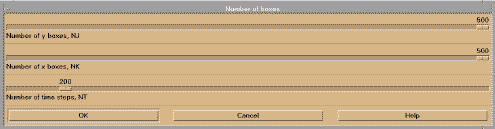
Simulations with a smaller number of squares run faster but produce less accurate results.
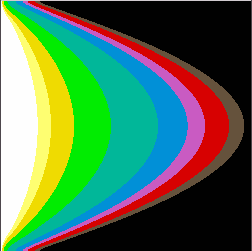
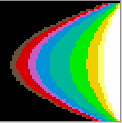
The flow of surfactant molecules along the cell and their diffusion to the surface is modelled using the Levich equation. This allows control of both flow rate and diffusion coefficent for the surfactant. The flow of molecules is assumed to be parabolic, which produces convincing results in most situations:
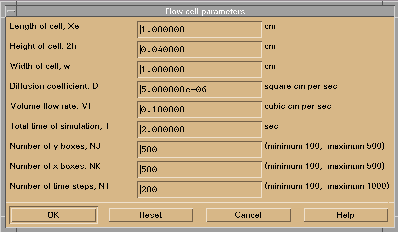
DynaSURF allows control of all flow cell parameters:
 The length of the flow cell, Xe
The height of the flow cell, 2h
The width of the flow cell, w
The diffusion coefficient, D. This dictates how quickly
surfactant diffuses to the surface. A higher value of diffusion coefficient
gives faster diffusion to the surface.
The volume flow rate, Vf. This dictates the rate of flow of
surfactant from left to right along the flow cell.
The total time of simulation, T. This is the maximum time of
the simulation, measured from the start of the simulation.
The number of y boxes, NJ. This is the number of boxes along
the y axis of the matrix in the simulation, and may vary between 100 and
500.
The number of x boxes, NK. This is the number of boxes along
the x axis of the matrix in the simulation, and may vary between 100 and
500.
The number of time steps, NT. This is the number of steps
taken for the simulation to reach its total time. A greater number of
time steps results in a more stable simulation, particularly when the
total time of simulation is several seconds.
 Back to DynaSURF Home Page